
Web3 Development for Traditional Developers: A Complete 2026 Guide
Web3 Development for Traditional Developers: A Complete 2026 Guide walks experienced Web2 developers through everything they need to transition into blockchain development — from understanding smart contracts and the Web3 tech stack, to writing Solidity, connecting a React frontend, and deploying to production — with practical code examples, security best practices, and a clear 4-month learning roadmap.
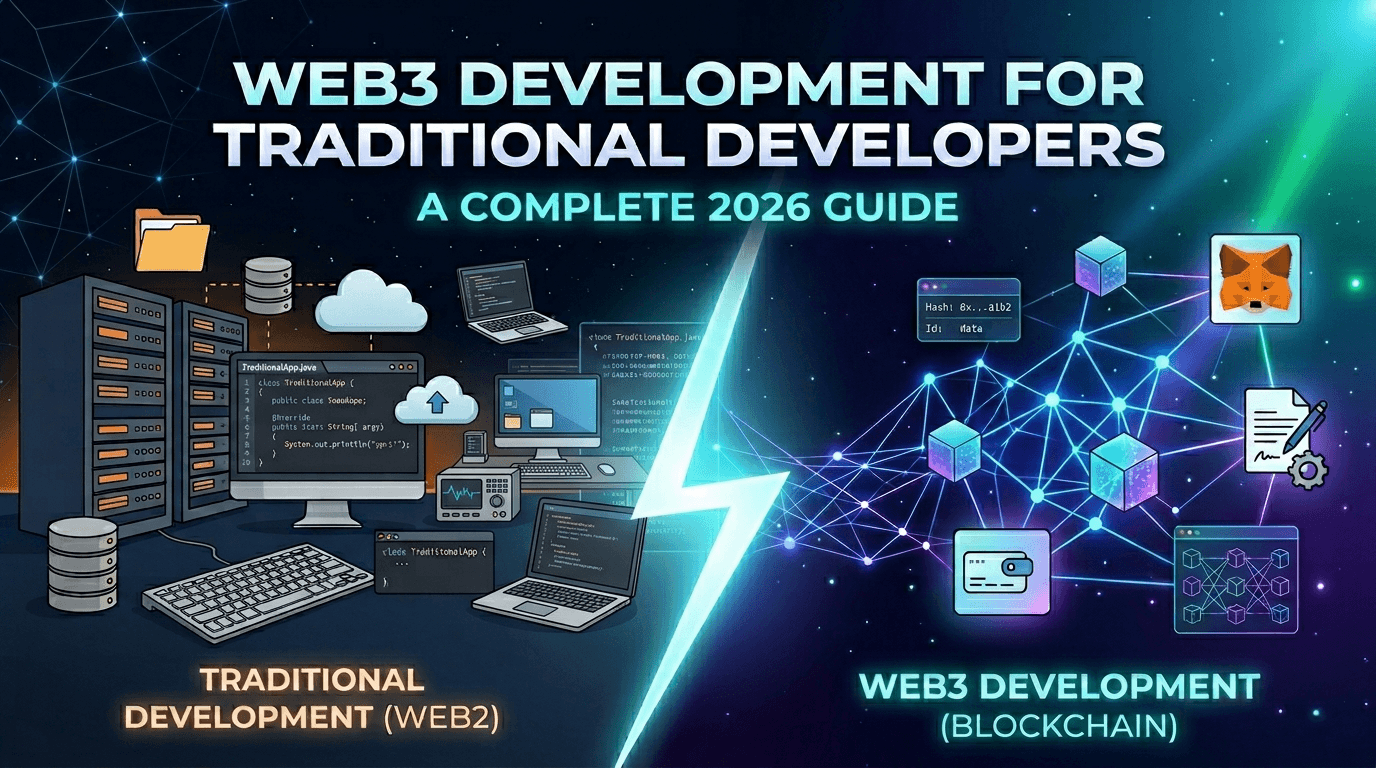
Web3 Development for Traditional Developers: A Complete 2026 Guide
The demand for Web3 developers has exploded. Companies are offering salaries 40–60% higher than traditional roles — and the technology is finally mature enough for mainstream adoption.
Prerequisites: Strong JavaScript / TypeScript · Backend APIs & databases · React or similar framework · No blockchain experience needed
Table of Contents
- What Is Web3 & Why Care?
- Blockchain for Developers
- The Web3 Tech Stack
- Your First Smart Contract
- Dev Environment Setup
- Frontend with React + Web3
- Common Patterns
- Advanced Concepts
- Security Best Practices
- Deploying to Production
- Real-World Architecture
- Challenges & Solutions
- Learning Roadmap
- Resources
1. What Is Web3 and Why Should You Care?
Web3 is the next evolution of the internet, built on blockchain technology. Instead of data living on company servers, it lives on decentralized networks that no single entity controls.
Web2 vs Web3
| Aspect | Web2 — Current Web | Web3 — Decentralized |
|---|---|---|
| Data Storage | Company servers (AWS, Google Cloud) | Blockchain networks |
| Data Control | Companies control access | You control with private keys |
| Authentication | Username / password | Crypto wallets |
| Trust Model | Trust Facebook, Google, banks | Code (smart contracts) executes automatically |
Why Developers Are Moving to Web3
💰 Average Web3 developer salary: $120k–$250k+
Beyond salary, Web3 offers cutting-edge work with blockchain, cryptography, and distributed systems. Most companies are fully remote, many offer token equity, and the industry is projected to be worth multiple trillions of dollars.
2026 Maturity Note: The technology has matured significantly — sub-second transactions, excellent developer tools, clear regulatory frameworks, and real-world applications beyond speculation.
2. Understanding Blockchain: A Developer's Perspective
Blockchain = Distributed Database
Think of a blockchain as a database where every transaction is a row in an append-only table, replicated across thousands of computers. No single person can alter historical records, and everyone can verify the data is correct.
Smart Contracts = Backend Code on the Blockchain
A smart contract is like a Node.js API, except it:
- Runs on the blockchain, not a server
- Cannot be changed once deployed
- Is callable by anyone
- Costs money ("gas fees") to execute
contract Bank {
    mapping(address => uint) public balances;

    function transfer(address to, uint amount) public {
        require(balances[msg.sender] >= amount);
        balances[msg.sender] -= amount;
        balances[to] += amount;
    }
}
Wallets = User Accounts with Private Keys
Instead of username/password, users have a wallet address (e.g. 0x742d35Cc...). They sign transactions with a private key, and the blockchain verifies the signature automatically.
Gas Fees = Paying for Computation
Every write operation costs "gas" — think of it like AWS charges for compute. Reading data is free; writing costs gas; complex calculations cost more. Users pay fees to miners/validators.
3. The Web3 Tech Stack
| Traditional Web | Web3 Equivalent | Purpose |
|---|---|---|
| Node.js / Express | Solidity / Smart Contracts | Backend logic |
| PostgreSQL / MongoDB | Blockchain | Data storage |
| AWS / Heroku | Ethereum / Polygon | Hosting / Infrastructure |
| REST API | JSON-RPC / Web3.js | Communication protocol |
| JWT / Sessions | Wallet signatures | Authentication |
| React / Vue | React / Vue + Web3 libraries | Frontend |
Core Technologies to Learn
- Solidity — Smart contract programming language (like JavaScript, but for blockchain)
- Ethers.js or Web3.js — JavaScript libraries to interact with blockchain (like Axios for APIs)
- Hardhat or Foundry — Development frameworks (like Express or Next.js)
- MetaMask — Browser wallet extension for testing and user auth
- IPFS — Decentralized file storage (alternative to S3)
4. Your First Smart Contract
Here's a TodoList — side-by-side in Node.js/Express and Solidity.
Traditional — Express
const express = require('express');
let todos = [];

app.post('/todos', (req, res) => {
  const todo = {
    id: todos.length,
    text: req.body.text,
    completed: false
  };
  todos.push(todo);
  res.json(todo);
});

app.patch('/todos/:id', (req, res) => {
  todos[req.params.id].completed = true;
  res.json(todos[req.params.id]);
});
Web3 — TodoList.sol
pragma solidity ^0.8.0;

contract TodoList {
  struct Todo {
    uint id;
    string text;
    bool completed;
  }
  Todo[] public todos;

  function createTodo(string memory _text) public {
    todos.push(Todo({
      id: todos.length,
      text: _text,
      completed: false
    }));
  }

  function completeTodo(uint _id) public {
    todos[_id].completed = true;
  }
}
Key Differences
- No Server Required — Deploy once to blockchain; it runs forever without maintenance.
- State is Permanent — Once written to blockchain, data is immutable.
- Public by Default — All data is visible; use encryption for private data.
- Users Pay for Usage — Users pay gas fees instead of you paying server costs.
- No Auth Code Needed —
msg.senderautomatically identifies the caller.
5. Setting Up Your Development Environment
Step 1 — Install Required Tools
# Install Hardhat (Web3 development framework)
npm install --save-dev hardhat

# Create new Hardhat project
npx hardhat

# Install Ethers.js
npm install --save-dev @nomicfoundation/hardhat-ethers ethers
Step 2 — Project Structure
my-web3-project/
├── contracts/       # Smart contracts (.sol files)
│   └── TodoList.sol
├── scripts/         # Deployment scripts
│   └── deploy.js
├── test/            # Contract tests
│   └── TodoList.test.js
├── frontend/        # React app
│   └── src/
└── hardhat.config.js
Step 3 — Configure Hardhat
// hardhat.config.js
require("@nomicfoundation/hardhat-ethers");

module.exports = {
  solidity: "0.8.20",
  networks: {
    hardhat: { chainId: 1337 },  // Local dev
    mumbai: {
      url: "https://rpc-mumbai.maticvigil.com",
      accounts: [process.env.PRIVATE_KEY]
    }
  }
};
Step 4 — Write SimpleStorage.sol
// SPDX-License-Identifier: MIT
pragma solidity ^0.8.0;

contract SimpleStorage {
  uint256 private storedValue;

  event ValueChanged(uint256 newValue);

  // Write (costs gas)
  function setValue(uint256 _value) public {
    storedValue = _value;
    emit ValueChanged(_value);
  }

  // Read (free)
  function getValue() public view returns (uint256) {
    return storedValue;
  }
}
Step 5 — Test & Deploy
# Run tests
npx hardhat test

# Start local blockchain
npx hardhat node

# Deploy to local network
npx hardhat run scripts/deploy.js --network localhost
6. Building the Frontend: React + Web3
Connect to MetaMask Wallet
// hooks/useWallet.ts
import { useState, useEffect } from 'react';
import { BrowserProvider } from 'ethers';

export function useWallet() {
  const [account, setAccount] = useState(null);
  const [provider, setProvider] = useState(null);

  const connectWallet = async () => {
    if (!window.ethereum) {
      alert('Please install MetaMask!');
      return;
    }
    const accounts = await window.ethereum.request({
      method: 'eth_requestAccounts'
    });
    const provider = new BrowserProvider(window.ethereum);
    setAccount(accounts[0]);
    setProvider(provider);
  };

  return { account, provider, connectWallet };
}
Transaction Flow Explained
- Connect Wallet — MetaMask opens → user approves → app gets wallet address.
- Initialize Contract — Create contract instance with address + ABI + signer.
- Read data (
getValue) — Free operation, no transaction, returns immediately. - Write data (
setValue) — MetaMask opens for approval → user signs → tx sent → wait for mining → event emitted → UI updates.
7. Common Web3 Patterns vs Traditional Patterns
Pattern 1: Authentication
Key Insight: In Web3, there is no login endpoint. The wallet connection is the authentication.
msg.senderin your smart contract automatically identifies the caller — no JWTs, no sessions, no bcrypt.
Pattern 2: Authorization / Permissions
// Access Control with modifiers
contract AdminPanel {
  address public owner;
  mapping(address => bool) public admins;

  constructor() { owner = msg.sender; }

  modifier onlyOwner() {
    require(msg.sender == owner, "Not owner"); _;
  }

  function addAdmin(address _admin) public onlyOwner {
    admins[_admin] = true;
  }
}
Pattern 3: Handling Payments
// Native ETH payments — no Stripe needed
contract Shop {
  uint public itemPrice = 0.01 ether;

  // payable = this function accepts ETH
  function buyItem() public payable {
    require(msg.value >= itemPrice, "Insufficient");
    if (msg.value > itemPrice) {
      payable(msg.sender).transfer(msg.value - itemPrice);
    }
  }
}
⚠️ Important: Don't store large data on-chain — it's extremely expensive. Use IPFS for files and large content, storing only the IPFS hash on the blockchain.
8. Advanced Concepts
ERC-20 Tokens (Cryptocurrencies)
ERC-20 is the standard for creating fungible tokens like USDC, DAI, and LINK. OpenZeppelin provides a battle-tested base contract you can simply extend.
import "@openzeppelin/contracts/token/ERC20/ERC20.sol";

contract MyToken is ERC20 {
  constructor(uint256 initialSupply) ERC20("MyToken", "MTK") {
    _mint(msg.sender, initialSupply * 10 ** decimals());
  }
}
NFTs (ERC-721)
NFTs are unique digital assets — art, collectibles, game items. Each token has a unique ID and can link to metadata hosted on IPFS.
Decentralized Storage with IPFS
Store images and files off-chain via IPFS (using a service like Pinata), then store only the IPFS hash in your smart contract. This gives you decentralization without paying on-chain storage costs.
Gas Optimization
// ✅ Cache array length, use calldata not memory
function addNumbersBatch(uint[] calldata _numbers) external {
  for (uint i = 0; i < _numbers.length; i++) {
    numbers.push(_numbers[i]);
  }
}

// ✅ Emit events instead of storage when you only need history
event ActionPerformed(address user, uint timestamp);

function performAction() public {
  emit ActionPerformed(msg.sender, block.timestamp);
}
9. Security Best Practices
Blockchain bugs cost millions of dollars and are irreversible. Follow these rules strictly.
1. Reentrancy Protection
// ✅ PROTECTED — update state BEFORE external call
import "@openzeppelin/contracts/security/ReentrancyGuard.sol";

contract Protected is ReentrancyGuard {
  mapping(address => uint) public balances;

  function withdraw() public nonReentrant {
    uint amount = balances[msg.sender];
    balances[msg.sender] = 0; // Update FIRST
    (bool success,) = msg.sender.call{value: amount}("");
    require(success);
  }
}
2. Integer Overflow
Solidity 0.8+ has built-in overflow protection — operations will revert instead of wrapping around. For older versions, use OpenZeppelin's SafeMath library.
3. Access Control
Always use require checks or OpenZeppelin's Ownable and role-based access control. Never assume a function is hard to find — all function selectors are public.
4. Input Validation
function transfer(address to, uint amount) public {
  require(to != address(0), "Invalid address");
  require(amount > 0, "Amount must be positive");
  require(balances[msg.sender] >= amount, "Insufficient");
  balances[msg.sender] -= amount;
  balances[to] += amount;
}
10. Deploying to Production
Choose a Network
| Testnets (Free) | Mainnets (Real Money) |
|---|---|
| Sepolia (Ethereum testnet) | Ethereum (most secure) |
| Mumbai (Polygon testnet) | Polygon (cheap, fast) |
| BSC Testnet | Arbitrum / Optimism (Layer 2) |
Get Test Tokens
Visit faucets to get free testnet tokens:
sepoliafaucet.com— Sepolia ETHfaucet.polygon.technology— Mumbai MATIC
Deploy & Verify
# Deploy to Sepolia testnet
npx hardhat run scripts/deploy.js --network sepolia

# Verify source code on Etherscan
npx hardhat verify --network sepolia CONTRACT_ADDRESS "1000000"
💡 Pro Tip: Contract verification lets users see your source code on block explorers like Etherscan — it builds trust and is effectively required for any serious project.
11. Real-World DApp Architecture
Production Web3 apps typically use a hybrid architecture — blockchain for trustless state, traditional backend for everything else.
| On Blockchain | Traditional Backend |
|---|---|
| Token transfers | User profiles & preferences |
| NFT ownership | Search and filtering |
| Critical state (who owns what) | Analytics & metrics |
| Money / payments | Email notifications |
| Image / file hosting |
Example Flow: NFT Mint
- User calls smart contract → NFT created on blockchain
- Frontend receives transaction hash
- Frontend sends tx hash to backend API
- Backend indexes the event, creates database record
- Backend generates thumbnail, updates search index
- User can now search/filter NFTs via traditional API
12. Common Challenges and Solutions
Challenge 1: Slow Transactions
Problem: Users wait 15+ seconds for confirmation.
Solutions: Use faster chains (Polygon, Arbitrum), show optimistic UI updates while waiting for on-chain confirmation, implement proper loading states with the transaction hash.
Challenge 2: High Gas Costs
Problem: Transactions can cost $50+ on Ethereum mainnet.
Solutions: Deploy to Layer 2 networks (Arbitrum, Optimism, Polygon), batch transactions when possible, use EIP-2771 for gasless transactions, or allow payment in tokens instead of ETH.
Challenge 3: Private Data
Problem: All blockchain data is public by default.
Solutions: Encrypt data before storing on-chain, store sensitive data off-chain and hash on-chain, or use zero-knowledge proofs for privacy-preserving verification.
Challenge 4: Upgrading Contracts
Problem: Code cannot be changed after deployment.
Solutions: Use the proxy upgrade pattern (OpenZeppelin's upgradeable contracts), plan for upgrades from the start with modular design, or use a multi-contract architecture where only non-critical logic is upgradeable.
13. 4-Month Learning Roadmap
Month 1 — Foundations
- Solidity basics (CryptoZombies)
- Set up Hardhat environment
- Deploy to testnet
- Build a wallet connection DApp
- Understand gas & transactions
Month 2 — Intermediate
- ERC-20 & ERC-721 standards
- Build a token & NFT project
- Testing with Hardhat
- Events and indexing
- Deploy to Polygon & Arbitrum
Month 3 — Advanced
- Security best practices
- Proxy upgrade patterns
- Full DApp (frontend + contracts)
- IPFS integration
- Deploy to mainnet
Month 4 — Production
- Web3 design patterns
- Gas cost optimization
- Monitoring & analytics
- Open-source contributions
- Build a portfolio project
14. Resources
Learning Platforms
- CryptoZombies — Interactive Solidity course
- Buildspace — Project-based Web3 courses
- Alchemy University — Free comprehensive curriculum
- LearnWeb3 — Structured learning path
Official Documentation
Tools
- Remix IDE — Browser-based Solidity IDE
- Hardhat — Ethereum development framework
- MetaMask — Browser wallet
- Etherscan — Block explorer
- Tenderly — Debug & monitor smart contracts
Community
- r/ethdev on Reddit
- Ethereum Stack Exchange
- Buildspace Discord
- Twitter: #Web3Dev #Solidity
Start Building Today
The transition from Web2 to Web3 isn't about learning entirely new skills — it's about applying your existing knowledge to a new paradigm.
Your next steps:
- Deploy a simple contract to testnet
- Connect a React app to your contract
- Let users write to your contract
- Join a Web3 developer community
- Keep building — each project teaches more